
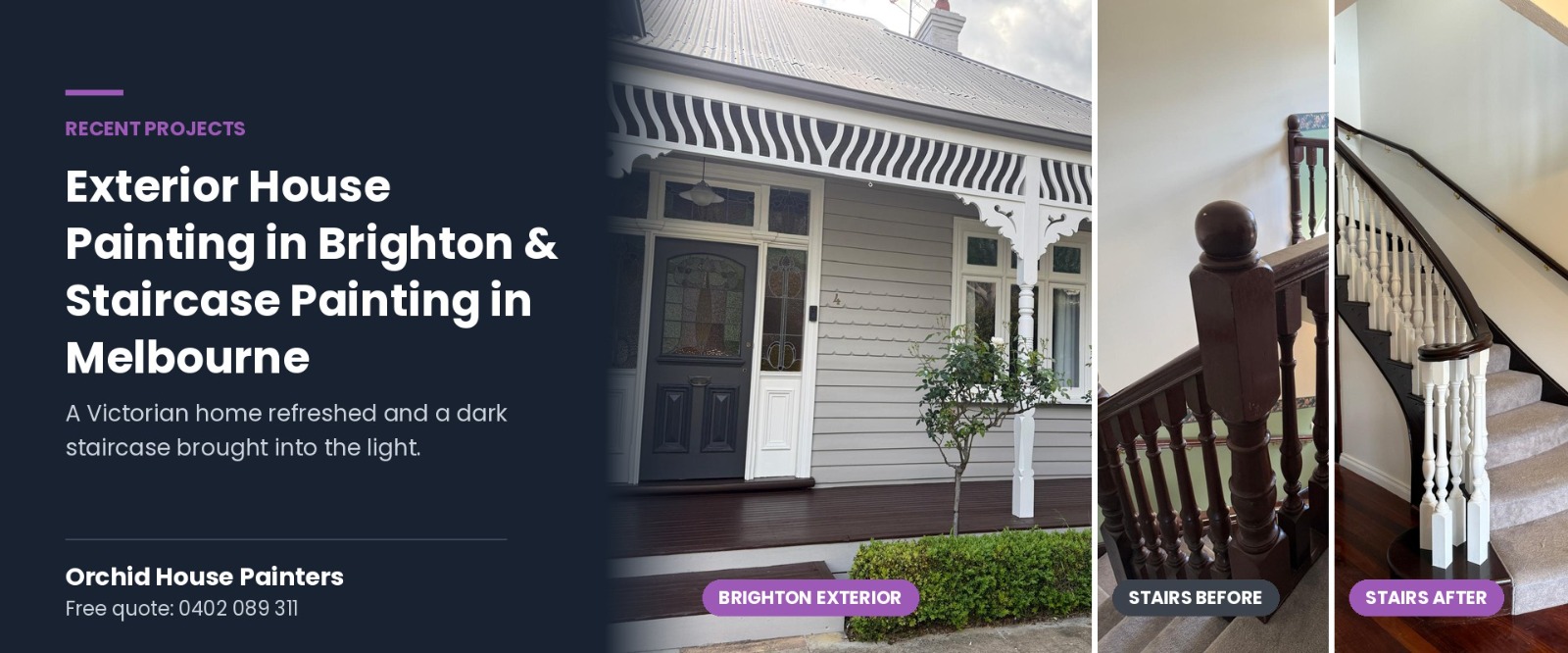
Two Recent Projects: Exterior House Painting in Brighton and a Staircase Makeover in Melbourne
We work on all kinds of residential and commercial projects; in the last two weeks, we completed a couple of projects, and often two jobs land close together, showing how painting work can change a place. This month, we did a classic Victorian weatherboard in Brighton and a heavy, dark timber staircase that badly needed some light. One job was outside the house, and one was inside the house, but the approach was the same: careful preparation with the perfect time and good quality of product and no shortcuts.
Here’s a look at both.
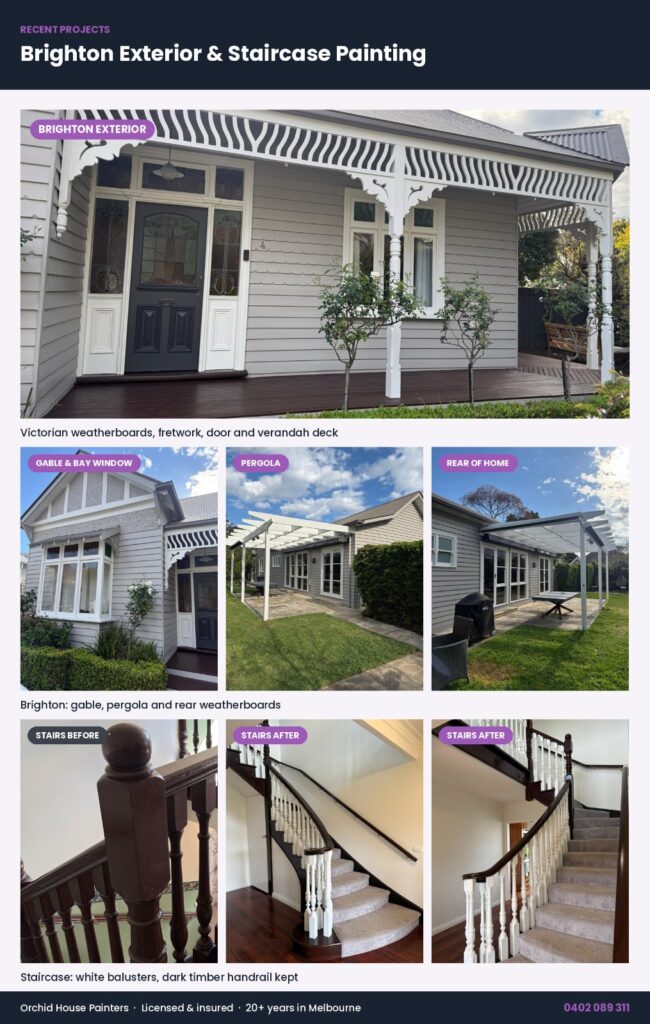
Exterior house painting in Brighton: a Victorian home done properly
Brighton is full of beautiful, stylish homes, and this one had all the details you would hope for. Lacework, fretwork across the verandah, decorative brackets, a stained-glass front door, and a stucco gable over a bay window.
Those details are what make a Brighton home special. They also make it tricky to paint. As you know, fretwork has hundreds of edges and curves, and you need to clean, sand and coat each of them one by one by hand. If you rush, you will get drips, missed spots and paint that starts lifting after one summer.
Here’s what the job included:
- Weatherboardsin a soft warm grey, with the scalloped detail boards picked out cleanly.
- Fretwork, brackets, posts and window framesin crisp white, hand-brushed to keep every curve sharp.
- Front doorin a deep charcoal, so the original stained glass really stands out.
- The verandah deck and stepswere recoated in a rich dark brown that ties in with the period style.
- The stucco gableis painted to match the walls, with the timber battens highlighted in white.
- The rear of the house, including the weatherboards, French doors and the big outdoor pergola, is now bright white against the grey.
The result is a home that looks fresh but still feels true to its age. That’s the balance we aim for with any heritage-style house. If you’re looking for exterior house painting in Brighton, choose a team comfortable with fine detail work, not just big, flat walls.
Staircase painting in Melbourne: from dark and heavy to light and open
The second job was inside a different home. The staircase was solid and well made, but everything was the same dark reddish-brown: handrail, balusters, posts, stringers and the upstairs landing. Add green walls and a floral border, and the whole entry felt closed in.
The owners did not want to lose the timber’s warmth completely. So we kept the handrail, newel posts and stringers dark and painted every baluster white. We painted the walls a clean, soft cream.
It is a simple idea, but it changes everything. The white balusters catch the light, the dark rail now reads as a feature instead of a shadow, and the curved staircase finally looks like the centrepiece it was meant to be.
Staircases take more patience than most people expect. Here’s how we handled it:
- Protect everything.New carpet and timber floors were fully covered before we started.
- Clean and sand.Varnished timber is slippery for paint, so we cleaned and sanded every baluster so the primer would grip.
- Prime with a bonding undercoat.This stops the dark stain from bleeding through the white.
- Two finish coats, by hand.Turned balusters have lots of curves, so we brushed them rather than spraying indoors.
- Touch up the dark timber.The handrail and stringers were refreshed so the contrast stays crisp.
If you’re searching for staircase painters near me, ask how they’ll deal with existing varnish. Skipping the sanding and bonding primer is the main reason painted stairs chip and peel.
Tips if you’re planning either job
For exterior painting: spring and autumn are the best seasons in Melbourne for painting work, which is why most people hire us during this time. We avoid painting when it’s over 35°C, and we plan coats around the Bureau of Meteorology forecast.
For staircases: Select a durable paint for balusters and railings, because hands will hit them harder in day-to-day life. Think about which parts stay timber and which go white. Keeping a dark colour combination on handrails is very practical because it hides marks.
Frequently asked questions
Can you paint a varnished staircase without stripping it?
Yes, in most cases we do it. Thorough cleaning, sanding and a good bonding primer are usually enough for varnishing. We only strip back the paint when the existing paint is flaking or badly damaged.
How long does staircase painting take?
It depends on the number of balusters, the design and how many colours are involved. We give you a clear timeframe after seeing it in person.
Do you paint Victorian and heritage homes in Brighton?
Yes. Period homes are some of our favourite jobs, and we take extra care with fretwork, stained glass surrounds and original timber.
Do I need to move out while you paint my stairs?
No. We work in sections and keep the area tidy, so you can usually use the house as normal.
Get a free quote from staircase painters and exterior painters you can trust
Orchid House Painters has been painting Melbourne homes for over 20 years. We’re fully licensed and insured; our quotes are upfront and itemised, and we don’t leave until you’re happy. Whether you need staircase painting in Melbourne, a full exterior repaint, or both, we’d love to help.
Call 0402 089 311 or request a free measure and quote. You can also see more about our painting services in Brighton.
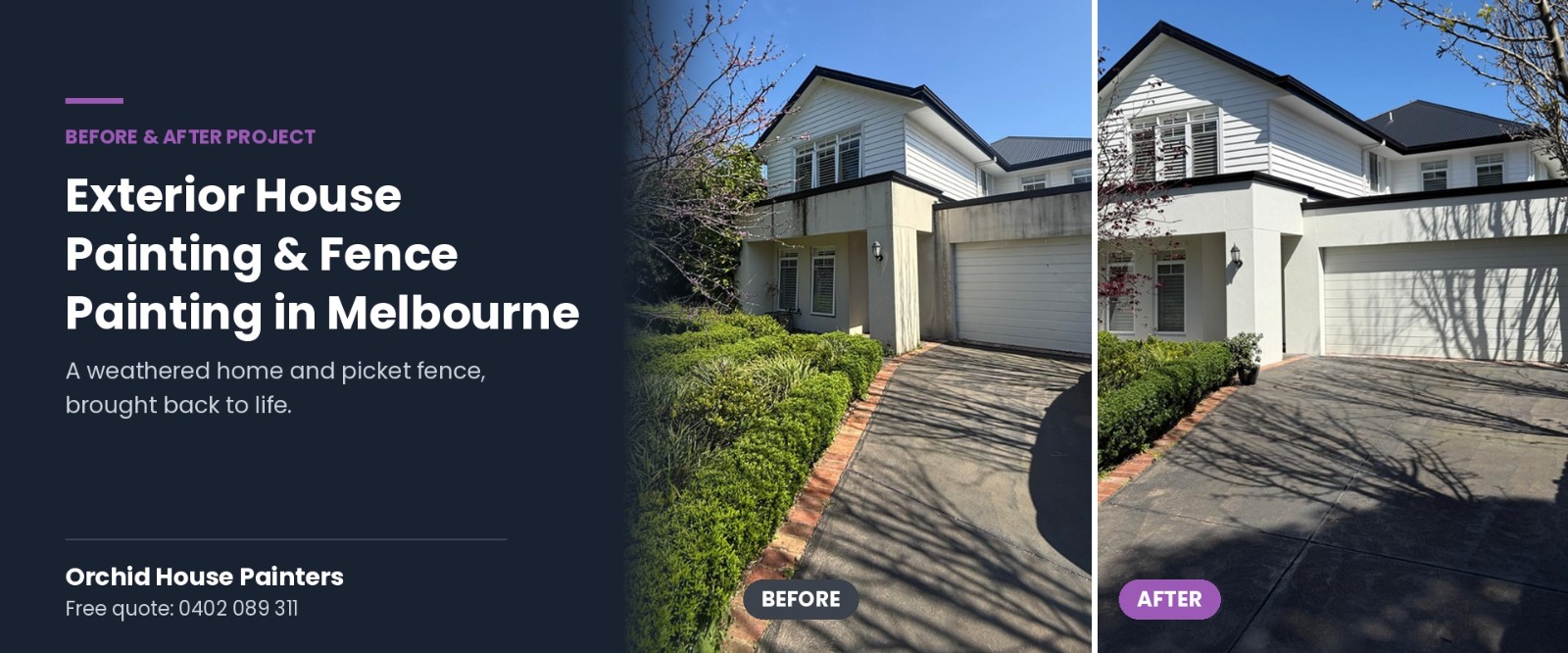
Before and After: How Exterior House Painting Brought This Melbourne Home (and Its Fence) Back to Life
Some houses don’t need a renovation. They need a proper paint job.
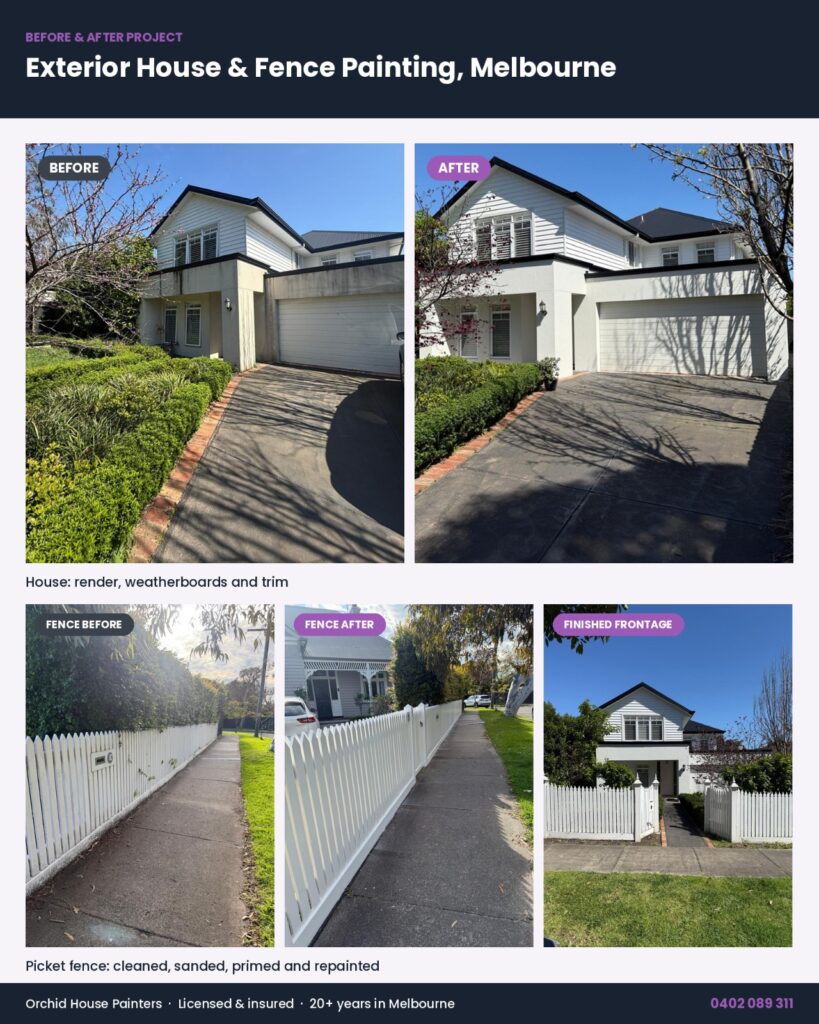
That was the story with this two-storey weatherboard home we finished recently. The bones were great: Hamptons-style cladding, plantation shutters, a tidy hedge and a classic white picket fence out the front. But years of Melbourne weather had worn it down. Dark streaks ran down the rendered front and garage from the roofline, the paint looked dull and patchy, and grime and mould crept along the bottom rail of the picket fence.
The owners didn’t want a new look. They wanted the house to look like it did when it was new. Here’s how we got there, and what you can take from it if you’re thinking about painting your own place’s exterior.
What the “before” photos told us
When you look closely at the before shot in the attached image below, you will se grey and black staining across the render. Mostly under the parapet and around the garage. During the monsoon, rainwater carries dirt and mould spores down the wall, which you can clearly see in the image. If left for a long time, it gets into the wall surface. SO you cannot just paint on it; you have to go through the process because the new paint will not grip it properly. Mostly, if you notice that fence has green and black marks, flaking at the base, nails are rusted, some of them are misaligned, and that looks tired even when the house behind it is fine. But you know why this happens: pickets that sit close to hedges and garden beds stay damp longer, and the bottom rail gets regularly splashed back by rain and sprinklers.
How we did it
Good exterior work is mostly preparation. The painting is the easy part. Here’s the process we followed:
- Clean and treat.We washed down the render, weatherboards and fence, then treated the mould so it doesn’t come straight back.
- We filled cracks in the render, sealed gaps, and sanded back loose or flaking paint on the pickets and posts.
- We primed bare timber and repaired patches so the topcoats bond evenly.
- Trim first, then walls.We start with fascias, window frames and gutters, then cut the walls in against them. It gives cleaner lines and saves time, which saves you money.
- Premium exterior paint made to handle Melbourne’s sun, rain and temperature swings.
- The fence.Picket by picket, including the edges, the gaps between pickets, the posts and the letterbox surround.
The result
The after photos say it better than we can. The render is crisp and even, the black fascia stands out again, the garage door looks brand new, and the picket fence is bright white from the cap of each picket down to the bottom rail. Same house, same colours, but it looks years younger from the street.
Why fence painting matters more than people think
Fences are the first thing people notice when they come to your home. It is not only the boundary but also frames the whole house, like the margin of a canvas; if you rember in childhood when we draw, we create a margin so the painting looks good. Because if the fencing are in bad condition it will drag down the value of you house. A clean one makes everything behind it look sharper.
Painting a fence in Melbourne takes a bit of know-how. Timber pickets deal with strong summer sun, wet winters and plenty of moisture from gardens. If you don’t clean, sand and seal the timber properly, the paint starts peeling within a couple of seasons. That’s why we always suggest doing the fence alongside the house. You get matching colours, one set-up, and one clean finish.
If you’re searching for fence painters near me, check that they prepare the timber properly and paint the edges and gaps, not just the faces you see from the footpath.
When is the best time for exterior painting in Melbourne?
We have vast experience in painting jobs, and spring and autumn are the best times for exterior painting in Melbourne. Because mild temperatures and lower humidity let the paint dry at the right pace. We mostly avoid painting above 35°C because the paint dries too fast to bond and leaves brush marks, giving the paint an improper texture once it dries. We also monitor the Bureau of Meteorology forecast and plan exterior coats around dry spells.
How to choose exterior house painters near me
If you’re comparing exterior painters in Melbourne, here’s what to look for:
- Licensed and insured.It protects your property and the people working on it.
- An itemised quote.Prep, materials, number of coats and clean-up should all be listed, so there are no surprises.
- Proper prep.Ask exactly how they’ll handle mould, cracks and flaking paint.
- Local experience.Melbourne weather is unpredictable, and experienced exterior house painters know how to work around it.
- Real before-and-after photosand honest Google reviews.
Frequently asked questions
How long does exterior house painting take?
It depends on wall size, the number of stories, surface condition and the weather. After a site visit, we give you clear start and finish dates.
How often should a timber picket fence be repainted?
As a rough guide, every few years. Fences in full sun or close to sprinklers and hedges usually need it sooner. As mentioned above, this happens for several reasons. Flaking at the base or dark marks on the bottom rail mean it’s time.
Can you paint the house and the fence in the same job?
Yes, and we recommend it. You get matching colours and a consistent finish, and it’s usually more cost-effective than booking them separately.
Which areas do you cover? We’re based in Balwyn North and work right across Melbourne, including the eastern, northern, southern and western suburbs and the CBD.
Ready to give your home the same fresh start?
Orchid House Painters has been painting Melbourne homes for over 20 years. We’re fully licensed and insured, provide upfront itemised quotes and don’t leave until you’re happy with the finish. Whether you need a full exterior repaint or want your picket fence looking sharp again, we’d love to help.
Call 0402 089 311 or request a free measure and quote today. You can also see more of our work on our projects page.